Corporate carbon accounting has advanced dramatically over the past decade. Organizations now have better tools, clearer standards, and more stable methodologies than ever before. Yet one stubborn obstacle continues to slow everything down. It is not emission factors. It is not the GHG Protocol itself. It is not calculating Scope 1, 2, or 3.
The real bottleneck, the challenge that consumes time, money, and morale, is the simple act of gathering reliable data from across the company.
This is the issue sustainability leaders talk about behind closed doors. It is the reason inventories take months, audits become stressful, and reporting seasons feel like fire drills. Until organizations fix this root problem, their carbon programs will always feel reactive and exhausting rather than strategic and efficient.
Anyone who has built a corporate greenhouse gas inventory knows that the majority of effort has nothing to do with emissions math. The real work happens far upstream. Sustainability teams must locate, request, extract, clean, validate, and ultimately trust dozens of internal data sources.
Energy bills, fuel purchases, refrigerant logs, waste invoices, water meters, procurement records, cloud usage reports, supplier questionnaires, employee commuting data, and business travel files all need to be collected long before emissions can be calculated. In most companies these data streams live in entirely different systems. They also tend to follow different reporting schedules and formats. Some are owned by accounting. Others by facilities. Others by procurement or operations or HR.
Research consistently shows that seventy to eighty percent of the total time spent on carbon accounting goes into finding and preparing data. This leaves sustainability teams with very little time to interpret results or drive emissions reduction initiatives. Nearly every corporate sustainability leader will admit that data collection, data cleaning, and data quality worries cause more stress than any other part of the reporting cycle.
The time burden is only one part of the problem. The second issue is cost. When data arrives late, incomplete, inconsistent, or locked in PDFs, teams must spend hours translating and reconciling it.
Many organizations rely heavily on consultants to do this cleanup work. This inflates project budgets and creates dependency on external partners for basic internal processes.
The third issue is credibility. Boards, auditors, and customers expect accurate and defensible data.
When important inputs are estimated or incomplete, sustainability teams feel pressure to over explain their assumptions. Many fear being accused of greenwashing even if they are doing their best with limited information.
The fourth issue is momentum. When reporting takes too long, companies lose valuable time that could be spent on emissions reduction planning, supplier engagement, and investment decision making. You cannot reduce what you cannot trust. You also cannot act quickly when your team is consumed by manual tasks that should be automated or centralized.
These concerns mirror the top worries that sustainability professionals report today. They include the time and expense required to collect data, the pressure to meet stakeholder expectations, the need for data accuracy and auditability, the challenge of managing Scope 3 information, and the difficulty of meeting ambitious climate goals in an environment of evolving standards.
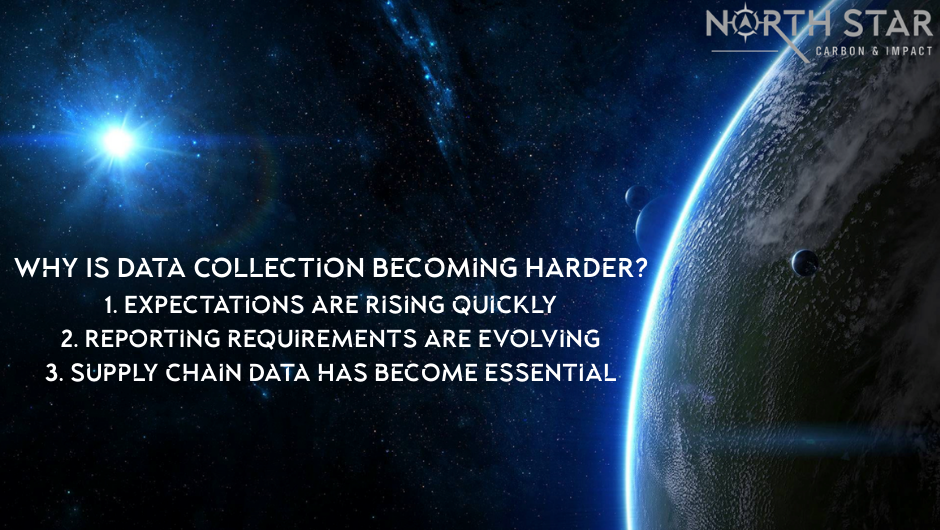
Even companies with mature sustainability programs are struggling more each year. Three major trends are accelerating this pressure.
Investors want greater transparency. Regulators are introducing more specific climate disclosure requirements. SBTi is tightening its guidance. B Lab is updating its framework. ISO standards are expanding. The bar keeps rising. This forces teams to refine their data collection methods every single year.
The GHG Protocol is updating its guidance. SBTi Net Zero Standard v2.0 is around the corner. The SEC and CSRD both require more detailed emissions data. To comply, companies need cleaner, more traceable, and more consistently structured data than ever before.
Scope 3 emissions often represent eighty to ninety percent of a company’s footprint. These categories depend on data from suppliers who may not have the systems or experience to provide reliable information. As a result, procurement and sustainability teams must manage a growing volume of supplier outreach and education. This adds complexity to processes that were already stretched thin.
The organizations that have broken through this wall share one common feature. They have centralized and automated their sustainability data workflows. Instead of hunting through emails or chasing spreadsheets, they use purpose-built carbon and ESG management systems to collect, organize, and validate information in a single place.
This approach is transforming carbon accounting for several reasons.
Energy, fuel, refrigerants, waste, business travel, water, procurement, cloud usage, and supplier information all live in one platform. Teams do not waste time locating data or confirming which version is the correct one.
Templates ensure that data arrives in the right format. Automated integrations eliminate manual uploads. This reduces errors and shortens project timelines.
North Star Carbon and Impact allows companies to give auditors instant access to every piece of information they need. This includes all raw source data, all calculations, all emission factors, all supporting documentation, and all notes or assumptions used. Audit teams receive full transparency in only two clicks.
This is a significant improvement over traditional reporting cycles where companies scramble to recreate the logic behind calculations months after data was originally compiled.
When auditors can immediately see where estimates were used and how they were developed, verification becomes smoother and far less stressful.
When sustainability teams are not buried under manual data tasks, they can turn their attention to the work that actually moves companies toward net zero. This includes identifying reduction opportunities, evaluating technology investments, and partnering with suppliers to drive real change.

Improving data collection unlocks benefits across the entire climate program. Companies get faster and more accurate inventories. They reduce consulting spend. They strengthen the credibility of their disclosures. They improve audit outcomes. They accelerate target setting and scenario analysis. Most importantly, they give their sustainability teams the time and clarity needed to lead real emissions reductions across the business.
Data collection is the single biggest bottleneck in corporate carbon accounting. It slows teams down. It increases costs. It creates audit anxiety. It limits strategic progress. But it is not inevitable.
With the right systems, companies can finally move beyond spreadsheets and fragmented workflows. They can create a clean, centralized, and auditor ready data environment that empowers them to meet modern climate expectations with confidence.
North Star Carbon and Impact was built specifically to make carbon accounting and sustainability management seamless, accurate, and transparent. It removes the burden of manual data collection and gives companies a clear foundation for credible, future ready climate performance.
03/11/2026
California has officially moved the market. With the adoption of SB 253 and SB 261 and the establishment of the first reporting deadline in August 2026, thousands of companies doing business in California will be required to disclose greenhouse gas emissions and climate-related financial risks. For many organizations, this will be the first time their […]
03/06/2026
The release of the GHG Protocol Land Sector and Removals Standard marks one of the most significant developments in corporate carbon accounting in over a decade. For companies involved in agriculture, forestry, fiber, food production, bioenergy, land development, apparel, consumer goods, mining rehabilitation, or carbon removal technologies, this Standard fundamentally reshapes how land-based emissions and […]
02/26/2026
For many organizations, carbon accounting does not fail because of methodology. It fails because of process. The GHG Protocol provides clear guidance on how to calculate Scope 1, Scope 2, and Scope 3 emissions. The real challenge is gathering accurate, complete, and consistent data across a complex organization without overwhelming internal teams. If your sustainability […]